

AI Evaluation & Testing
Know exactly what your AI systems can do — and what they can’t.
AI systems require structured evaluation across performance, bias, compliance and transparency for optimal functionality.
We provide tailored assessments, technical testing and evaluation before and after deployment, covering your AI system’s entire lifecycle.

01
AI Impact Assessment
AI systems affect people and the planet — employees, customers, communities and the environment. Before deployment or scaling, organizations need to understand what those effects are and how to minimize risks.
Why it matters
AI systems aren't perfect. People are ultimately responsible for the results. That's why humans must be able to control AI, rather than losing control by blindly accepting outputs of the technology.
Our assessment framework
We use proven international state of the art methods developed by the EU, Council of Europe (HUDERIA), and the Austrian Labs for AI Trust.
Legal & ethical context
EU AI Act, Product Liability Directive, GDPR, Medical Device Regulation, anti-discrimination laws and many more – we map your use cases to the relevant requirements.
What we assess
Functionality and performance, subgroup performance & biases, impact on individuals and communities, robustness, data privacy, regulatory compliance, data and stack sovereignty.
Deliverables

-
Identify affected stakeholder groups
Assess stakeholder-specific AI risks
Prioritize risks across the AI lifecycle

-
Comprehensive AI impact analysis
Risk and compliance evaluation
Practical recommendations for safe AI deployment

-
Tailored risk mitigation strategies
Governance, technical & organizational measures
Actionable implementation roadmap
02
AI Bias Management
Bias in AI systems cannot be managed with a one-time fix. It is deeply embedded in most AI systems, entering through data, design and human-AI interactions — and can lead to incorrect and harmful results. We manage it as a continuous service, from inception to real-world use.
1. Initial AI Bias Assessment
Using our ABBRA bias database, we conduct an initial assessment of bias risks tailored to each AI use case of our clients, the technology used, and the sector.


2. Bias Testing of AI System
We test AI systems using appropriate test designs to determine whether bias is actually a problem—for which groups of people and to what extent.


3. AI Bias Reduction
Results from testing are the starting point to develop specific strategies to minimise AI bias in an evidence-based manner.

4. Ongoing AI Bias Monitoring
After bias has been identified, tested and reduced, the system continues to be checked for bias during real-world use.

Deliverables

-
Initial AI Bias assessment report including risk classification
Testing design and strategy tailored to the respective AI systems
Test Data Requirements

-
Conducting bias testing of AI systems, including testing data quality checks
AI Bias testing results report including concrete recommendations
Deployment readiness report

-
AI Bias Mitigation Roadmap with concrete recommendations
Evaluation of the Effectiveness of Bias Mitigation
AI Bias Monitoring Concept and Implementation Support
03
AI Quality
Quality in AI means more than accuracy and depends on many factors, such as user expectations, deployment context and regulatory requirements.
We evaluate AI systems and use cases across the full range of quality dimensions, ranging from robustness and explainability to security and sustainability.
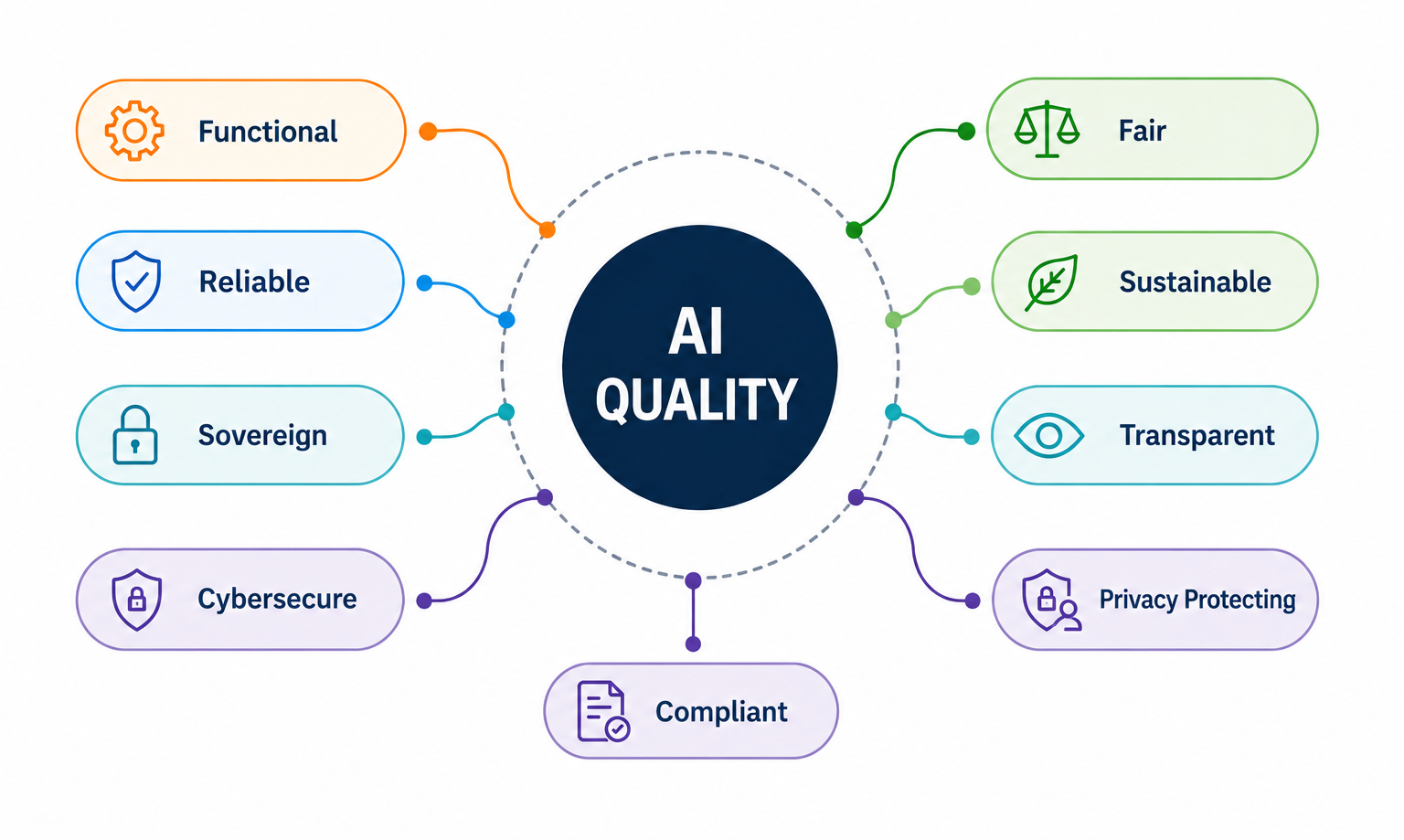
AI Quality covers both existing systems and potential use cases, supporting procurement decisions, make-or-buy evaluations and system comparisons.
Defining AI Quality Requirements
Organization-specific quality framework
Prioritization by use case and AI strategy
Provider and deployer requirements
Metrics for each quality dimension
Implementation roadmap
Back-integration into governance
AI Quality Assessment
Testing against defined quality requirements
Documentation review
Evaluation Report and output-level findings
Final Analysis, interpretation and recommendations
Deliverables
-
Organization-specific quality strategy
Prioritized AI quality dimensions
Strategic implementation roadmap
-
Tailored quality requirements
Use case and technology-specific criteria
Stakeholder-oriented quality objectives
-
Comprehensive quality evaluation
Performance and risk analysis
Actionable assessment results
How Our Graphic Maps Onto Standard AI System Lifecycles
The AI System Stages of Progression combines two different perspectives on the AI System. On the one hand, there is the overall AI system life cycle – a view particularly relevant for developers of AI systems, and defined in international standards such as ISO/IEC 22989:2022 and ISO/IEC 5338:2023.
While these are generic life cycle model, intended to be used also for organizations procuring and deploying AI systems, we have chosen to give equal weight to the view of organizations purchasing and deploying AI systems, by including it as a second, separate perspective.
-
This maps onto the “Inception” phase of the ISO/IEC life cycle model.
-
This maps onto the Design and Development phase of the ISO/IEC life cycle model.
-
This is identical to the ISO/IEC life cycle model.
-
This is identical to the ISO/IEC life cycle model.
-
This is identical to the ISO/IEC life cycle model.
-
This collapses the continuous validation phase, which applies to continuous learning systems, into the Re-evaluation phase.
-
This maps onto the ISO/IEC Retirement phase.